In the heart of Africa’s quest for sustainable growth lies a plant that has been underestimated for decades—bamboo. Once seen as a simple fencing material or forest grass, bamboo is now rising as a green economy powerhouse, capable of generating billions in revenue, creating climate-smart jobs, and replacing high-emission raw materials in key industries. Africa’s bamboo moment has arrived, and Nigeria is uniquely positioned to lead this revolution.
Why Bamboo, and Why Now?
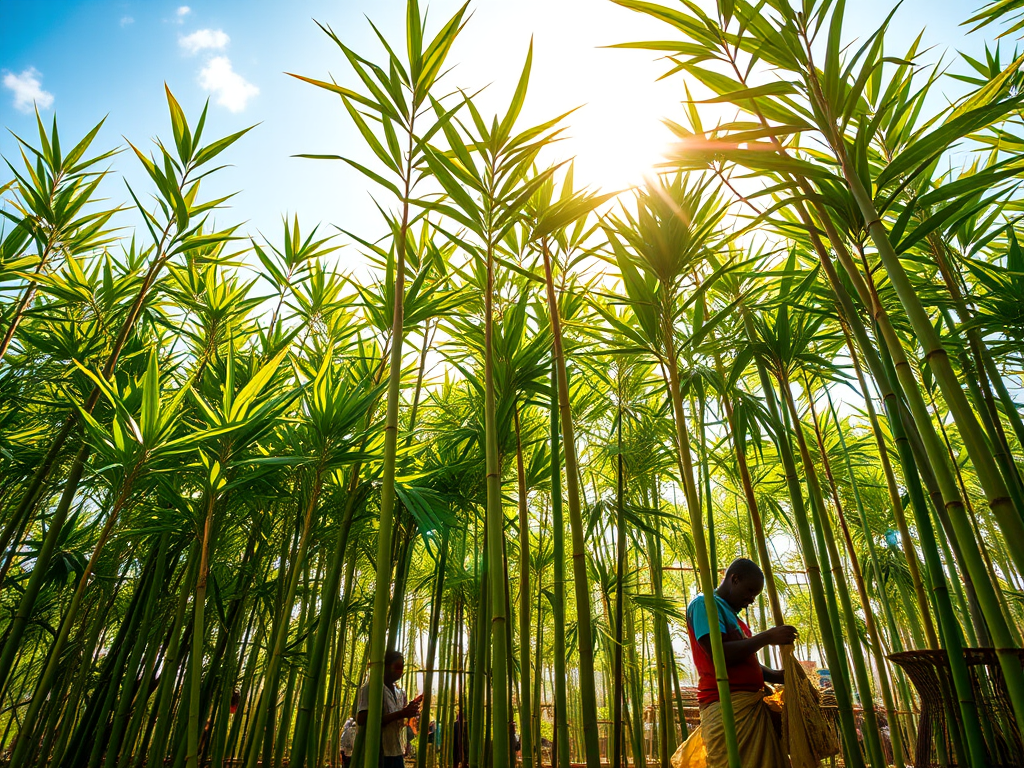
Bamboo is not a tree—it’s a woody grass that matures within 3–5 years and regenerates without replanting. Unlike hardwoods that take decades, bamboo grows quickly, thrives in marginal soil, and sequesters up to 12 tons of CO₂ per hectare annually, making it an essential tool in the fight against climate change. Globally, the bamboo industry is projected to be worth $98 billion by 2028. Africa currently earns a small fraction of that, but with over 7 million hectares of bamboo-rich landscapes, the continent is sitting on untapped green gold.
Nigeria’s Bamboo Advantage
Nigeria has over 1.7 million hectares of natural bamboo, yet less than 5% is commercially utilized. In Kogi State, small-scale processors are producing bamboo charcoal, furniture, and construction panels with annual earnings reported between ₦15 million and ₦25 million. This is without large-scale infrastructure.
In Ogun and Ondo, artisans are exporting handmade bamboo furniture and crafts to diaspora markets. Meanwhile, the Sahelian Institute for Bamboo Research and Entrepreneurial Development (SIBRED) is training a new generation of bamboo entrepreneurs and advocating for processing hubs across the country.
Most notably, Nigeria is constructing its first bamboo industrial park in Kogi, targeting products like toothpicks, floor tiles, briquettes, and laminated furniture panels.
Africa-Wide: Case Studies of Success
Ethiopia: With over 1 million hectares of bamboo, Ethiopia is earning millions of dollars in carbon credits through Verified Carbon Standard (VCS) schemes. Farmers in regions like Sidama and Oromia have been trained to manage bamboo forests sustainably while selling carbon offsets to global buyers.
Kenya: Kenya’s Green Economy Strategy includes bamboo as a key non-timber forest product. The Kenya Forestry Research Institute (KEFRI) and China’s INBAR have helped farmers establish bamboo nurseries and bamboo charcoal plants. Some cooperatives now export bamboo briquettes to Europe as clean cooking fuel.
Uganda: Uganda is piloting bamboo for land restoration and power generation. Bamboo plantations in Mount Elgon and western Uganda are already feeding into off-grid biomass energy systems. The government has included bamboo in its national climate adaptation plan.
Business Opportunities in Bamboo
Across the value chain, bamboo offers real commercial opportunities:
- Farming: With yields of 10,000–20,000 poles per hectare, farmers can earn up to ₦10 million/year.
- Processing: Entrepreneurs can start small with ₦5–6 million for equipment to make charcoal, cutlery, toothpicks, or panels.
- Crafts & Decor: Export-ready products with high margins.
- Bioenergy: Bamboo briquettes and ethanol are clean fuel alternatives.
- Carbon Credits: Farmers and cooperatives can monetize their climate impact via carbon offset platforms.
What’s Holding Us Back?
- Low awareness: Many African farmers still see bamboo as a wild plant, not a cash crop.
- Technology gap: Most regions lack affordable machinery for processing bamboo competitively.
- Weak policy incentives: Bamboo is rarely included in national agricultural or industrial plans.
The Way Forward: Time to Act
Bamboo must be mainstreamed into Africa’s green industrial policy. Governments should offer incentives—like tax breaks or startup grants—for bamboo processors. Investors need to treat bamboo as a climate-resilient asset, not a niche project. And farmers, cooperatives, and startups must begin to organize value chain clusters for scale.
Final Thoughts
Bamboo is not the future—it is the now. It can absorb carbon, create jobs, feed industries, and diversify Africa’s export base. If well-structured, the bamboo value chain could become a $10 billion annual industry for Africa by 2030. But this will only happen if visionary players act today.
Whether you’re an agripreneur, policy thinker, or investor, bamboo offers unmatched triple-bottom-line returns: profit, people, and planet.
Want to Learn More?
Subscribe to our Agribusinessspace blog for more insights, how-to guides on agribusiness ventures in the different agricultural value chains in Nigeria and across Africa.